Data, Information, and Knowledge
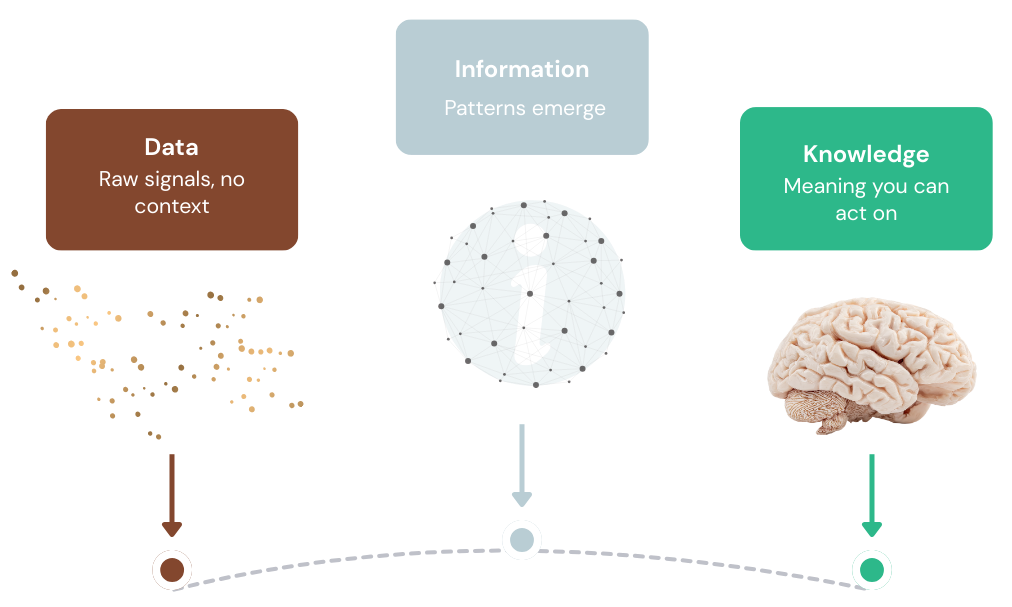
The terms data, information, and knowledge are often used interchangeably.
In practice they describe different stages in how systems transform raw input into reusable understanding.
For intelligent systems, the distinction matters.
If these stages blur together, systems accumulate unreliable memory and degrade over time.
Understanding the difference clarifies how memory systems should behave.
Data
Data is raw input.
It is an observation or artifact that has entered the system but has not yet been interpreted or structured. Messages, documents, sensor readings, API responses, embeddings, external datasets. At this stage the system simply receives signals.
Data alone does not imply meaning, correctness, or usability. It is simply what the system has observed.
Information
Information is data with structure and context.
When data is organized and contextualized, it becomes something the system can reason about. Structured information carries identifiers, timestamps, contextual metadata, relationships to other records, and provenance describing where the data originated.
The same raw input can produce different information depending on how it is structured.
Information is therefore interpretable state, not just raw observation.
Knowledge
Knowledge is information that can be reused for reasoning or decisions.
For a system, knowledge emerges when information is validated, connected to other information, and made accessible for future reasoning. It is what allows a system to answer questions about what has happened before, what relationships exist, and what conclusions can be drawn from past events.
In other words, knowledge is durable understanding built from structured information.
Where Systems Often Break
Many intelligent systems treat these stages as equivalent.
Raw inputs are stored immediately and later retrieved during reasoning.
The system assumes that everything written to memory is usable.
When this happens, unreliable information becomes persistent memory. Provenance becomes unclear. Reasoning chains inherit earlier mistakes, and system knowledge degrades over time.
The problem is not the model. It is how memory forms.
Enforcing the Transition
A reliable system needs a controlled transition between these stages.
When the transformation from data to information is controlled, the system can ensure that only appropriate inputs become durable state.
When information is admitted and connected, it can safely become reusable knowledge.
Governed Memory
Governed memory systems treat memory formation as a controlled process rather than a passive write path.
State is admitted only after policy checks and provenance requirements are satisfied.
Admitted information then becomes part of the system’s knowledge graph and can safely participate in future reasoning.
Synaptik Core implements this model as a governed memory system where writes are evaluated before mutation, admitted state carries provenance, and structured memory becomes reusable knowledge.
The goal is not to filter outputs after the fact, but to ensure that system knowledge forms in a controlled and traceable way.
The Takeaway
Data, information, and knowledge are not interchangeable.
They represent different stages in how systems convert raw signals into durable understanding.
When memory systems respect this progression, intelligent systems reason over state that is coherent, traceable, and reliable.